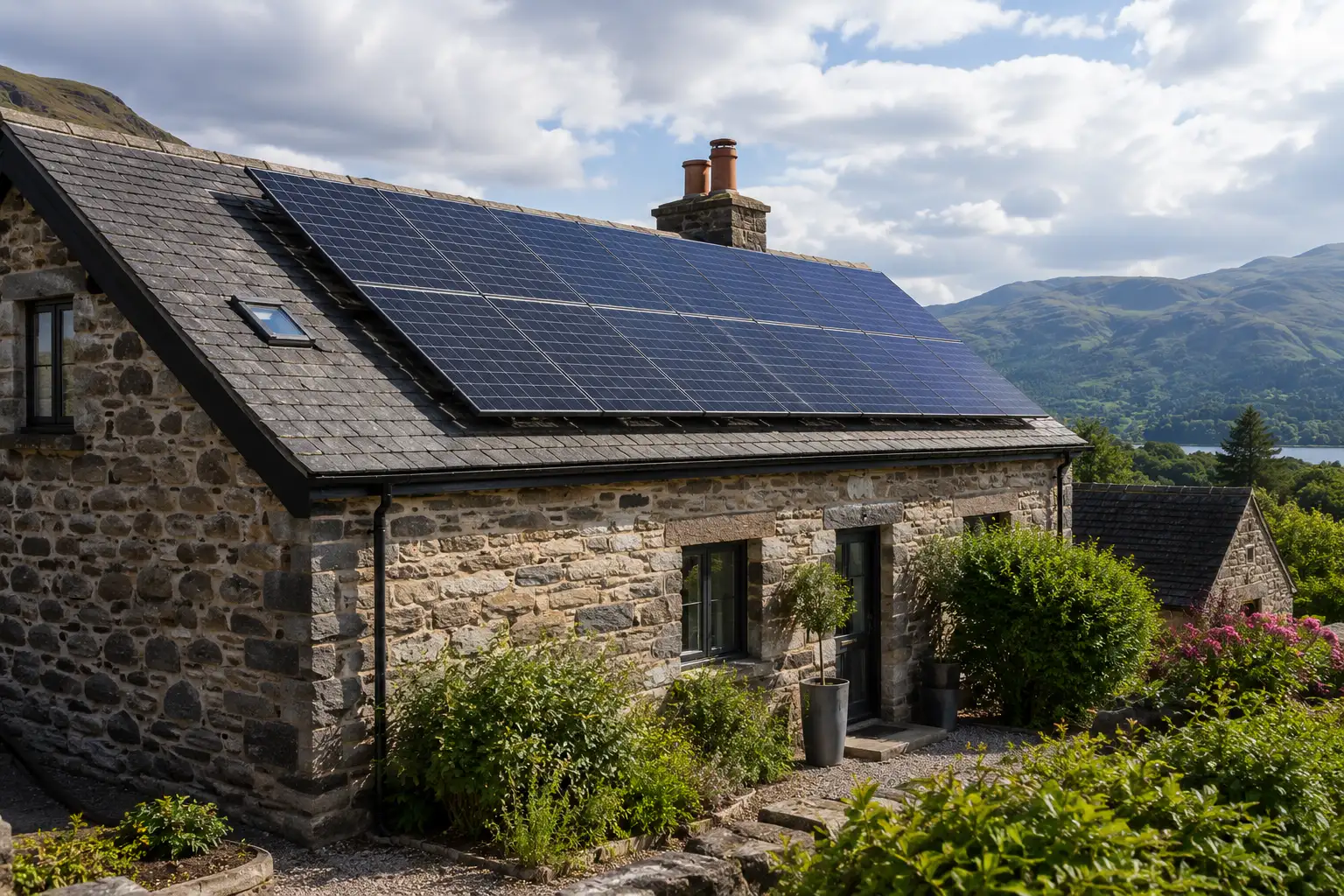
Solar panels typically last 25–30 years in Scotland. Scotland’s cloudy, cool climate does not significantly shorten solar panel lifespan; in fact, cooler temperatures can improve panel efficiency. Most panels degrade at around 0.5% per year, meaning they still perform at roughly 87% capacity after 25 years.
Lifespan is one of the first things Scottish homeowners ask about before going solar. It makes sense. This is a significant investment, one you want to last. The good news? Solar panels are built to endure decades of real-world weather, including the kind Scotland delivers in abundance.
Whether you’re based in Perth, Stirling, or anywhere across central Scotland, this post will walk you through everything you need to know: how long panels realistically last, how Scotland’s weather affects them, what degradation actually looks like in numbers, and what to look for in a warranty before you sign anything.
What Is the Average Solar Panel Lifespan?
Most modern solar panels are rated to last 25 to 30 years. That’s the industry standard backed by decades of performance data from manufacturers and independent researchers.
After that point, panels don’t simply stop working. They continue generating electricity, just at a slightly reduced output. Many systems well past the 25-year mark still produce usable power.
So when installers or manufacturers talk about “lifespan,” they’re typically referring to the period during which your panels perform above a guaranteed efficiency threshold, not the point at which they give up entirely.
Does Scotland’s Climate Affect How Long Solar Panels Last?
This is the big concern for most Scottish homeowners. Scotland is famous for its grey skies, rain, and wind, not exactly the image you picture when you think “solar power.”
Here’s what the data actually shows.
Rain and clouds don’t degrade panels. Solar panels are weatherproof by design. They’re built to handle rain, frost, and heavy wind. A wet roof in January doesn’t shorten a panel’s life, it often cleans it.
Cool temperatures can actually help. Solar panels generate electricity more efficiently in cooler conditions. Excessive heat is harder on the components than cold. Scotland’s moderate temperatures are, surprisingly, a mild advantage here.
Wind and storms are worth noting. Panels installed to a proper standard, with MCS-certified fittings and a solid structural survey, handle Scottish wind without issue. Poor installation is the real risk, not the weather itself.
The short version: Scotland’s climate is not the obstacle it might seem. A quality installation holds up well for the full 25–30 year lifespan.
Understanding Solar Panel Degradation Rate
No panel maintains 100% output forever. Over time, performance gradually decreases, this is called the solar panel degradation rate.
For most modern panels, that rate sits at around 0.5% per year. According to the National Renewable Energy Laboratory (NREL), the median degradation rate across a large sample of panel types is approximately 0.5% annually.
Here’s what that looks like in practice over 25 years:
- Year 1: ~100% output
- Year 10: ~95% output
- Year 20: ~90% output
- Year 25: ~87.5% output
That means after a full 25 years, your panels are still generating close to 90% of their original capacity. For most households, that’s a meaningful, ongoing reduction in energy bills, long after the system has paid for itself.
Premium panels from established manufacturers sometimes advertise degradation rates as low as 0.3% per year. When comparing products, this is a number worth asking about.
Solar Panel Warranty Scotland: What You Need to Know
Warranties can be confusing, and they vary between products and installers. There are two main types to understand:
Product Warranty (Manufacturing Warranty)
This covers defects in materials and workmanship; basically, if something is physically wrong with the panel itself. Standard product warranties run 10 to 15 years, though some premium brands offer up to 25.
Performance Warranty
This is the one most relevant to long-term output. A performance warranty guarantees your panels will maintain a minimum efficiency level over a set period, commonly 80–90% output over 25 years.
If a panel drops below that threshold earlier than expected, the manufacturer is obligated to repair or replace it.
What to watch for in Scotland: Make sure both warranties are backed by an established manufacturer with a track record. A warranty is only as good as the company standing behind it. This is one area where choosing a reputable local installer, one that sources from trusted brands, genuinely matters.
What to Ask Your Installer Before You Commit
Before you agree to any solar panel installation Scotland, run through these questions:
- What is the panel degradation rate? Ask for the specific figure, ideally 0.5% or below per year.
- What does the performance warranty cover? Get the exact percentage and timeframe in writing.
- Are you MCS-certified? MCS certification is a legal requirement for grid-connected solar in the UK. It also unlocks the Smart Export Guarantee (SEG), which lets you earn money by selling surplus energy back to the grid.
- Who completes the installation? Some companies subcontract work. An in-house team is more accountable.
- Is a structural survey included? This confirms your roof can safely support the panels, essential in older Scottish properties.
- What aftercare do you provide? Ask about monitoring, servicing, and what happens if something goes wrong post-installation.
These aren’t awkward questions. A trustworthy installer will welcome every one of them.
Helpful Tips: Do’s and Don’ts for Long-Lasting Solar Panels
Do:
- Schedule a professional clean every 1–2 years. Scotland’s rain helps, but moss and debris can build up on north-facing sections of a roof.
- Monitor your system output regularly. Most modern inverters connect to an app. A sudden drop in generation is often the first sign of a fault.
- Keep gutters clear. Overflow can affect roof-mounted panels over time.
- Check for shading changes. Trees grow. A panel that had clear sun exposure in year one may be partially shaded in year ten. Trimming back overhanging branches helps.
Don’t:
- Ignore the inverter. Panels last 25–30 years; inverters typically last 10–15. Budget for a replacement mid-system life.
- Assume more panels automatically means more savings. The right system size matters more than sheer panel count. A well-designed 10-panel system often outperforms a poorly designed 16-panel one.
- Delay getting a fault checked. Small issues, like a cracked cell or a loose connection, worsen over time. Early repair is always cheaper than late repair.
- Skip the survey. Installing panels on a structurally unsuitable roof creates problems that no warranty will cover.
Why Choose Home Heating Services Scotland?
Home Heating Services Scotland is a Perth-based renewable energy installer serving homeowners and businesses across central Scotland. The team is MCS-certified and brings over 20 years of combined experience to every job, managing the full process in-house, from initial survey through to commissioning and aftercare.
Their solar packages include 10 × 435W panels and a Fox inverter, with optional battery storage (5kWh to 15kWh) for households that want to maximise self-consumption. Systems are SEG-ready, meaning you can register to earn money from surplus energy exported back to the grid.
Finance options are available, and every installation comes with full MCS certification and transparent pricing, no hidden costs, no pressure.
As Martin and Louise from Perth put it: “Couldn’t be happier with our solar installation. From survey to installation the service was excellent, professional, honest and local. We’re already seeing lower bills and love checking the app to see what we’re generating.”
Solar Panels in Scotland: Worth It for the Long Haul
The numbers are clear. A quality solar panel system installed in Scotland today will realistically generate clean electricity for 25 to 30 years, and often beyond. Scotland’s climate is not a barrier. Cloudy skies still produce usable solar energy, cool temperatures support panel efficiency, and modern panels are built to withstand everything Scottish weather throws at them.
The key is getting it right from the start: the right panels, the right warranties, and the right installer.
If you’re ready to find out what a solar system could save your household each year, get a free quote from the team at Home Heating Services Scotland today: https://homeheatingservicesscotland.co.uk/
FAQ: Solar Panel Lifespan in Scotland
How long do solar panels last in Scotland specifically?
Solar panels in Scotland last the same 25–30 years as panels elsewhere in the UK. Scotland’s cool, wet climate does not meaningfully reduce panel lifespan and may slightly improve efficiency in warmer months.
Do solar panels work on cloudy days in Scotland?
Yes. Solar panels generate electricity from daylight, not direct sunlight. Output is lower on heavily overcast days, but panels continue producing usable energy year-round, including Scotland’s grey winter months.
What is a typical solar panel degradation rate in the UK?
The median solar panel degradation rate is approximately 0.5% per year, according to the National Renewable Energy Laboratory (NREL). After 25 years, most panels still operate at around 87–90% of their original capacity.
What does a solar panel performance warranty cover in Scotland?
A performance warranty guarantees your panels will maintain a minimum output, typically 80–90%, over a defined period, usually 25 years. If panels fall below that threshold, the manufacturer is required to repair or replace them.
When does a solar inverter need to be replaced?
Inverters typically last 10–15 years, compared to the 25–30 year lifespan of the panels themselves. Homeowners should budget for at least one inverter replacement during the full life of their solar system.
Is MCS certification important when choosing a solar installer in Scotland?
Yes. MCS (Microgeneration Certification Scheme) certification is required for grid-connected solar installations in the UK. It also makes your system eligible for the Smart Export Guarantee (SEG), allowing you to earn payments for surplus energy exported to the grid.