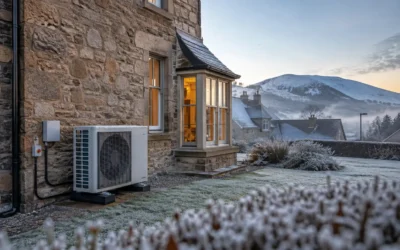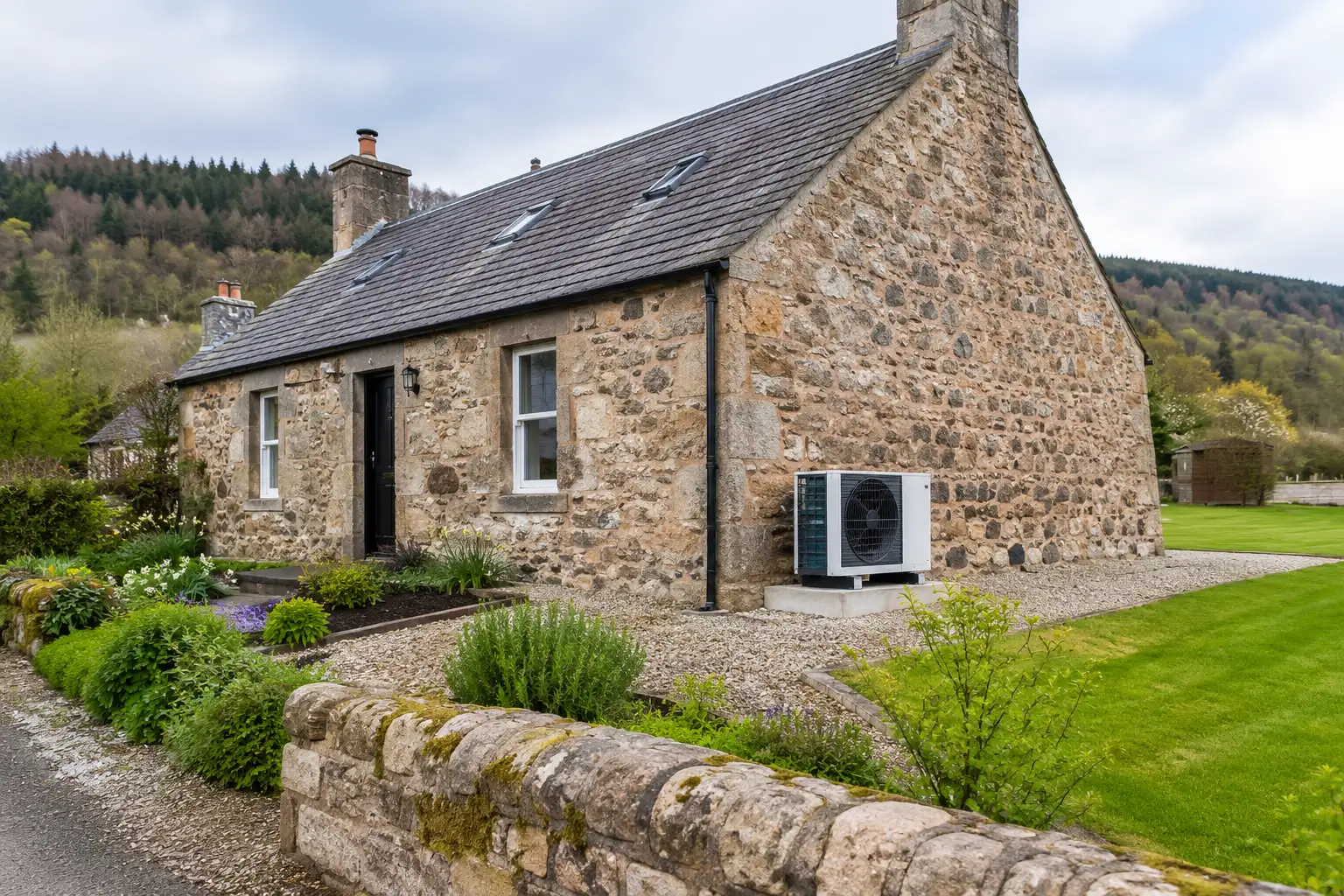
Yes, you can install a heat pump in an old Scottish stone house but it needs to be planned properly. The right insulation levels, correct radiator sizing, and an accurate heat-loss assessment are essential. With the right approach, a domestic air source heat pump installation can work brilliantly in traditional properties across Perth and central Scotland.
If you own an older stone property in Perth or Perthshire, you’ve probably had this thought: heat pumps sound great, but surely they’re not for a house like mine?
It’s a fair concern. Stone houses are thick-walled, draughty in places, and built long before modern heating systems existed. But the truth is, heat pumps can and do work in older Scottish homes. The key is knowing what to look out for and getting the system designed correctly from the start.
Here’s what you actually need to know.
Why Do People Worry About Heat Pumps in Older Homes?
The concern usually comes down to one thing: efficiency. Heat pumps work best when a home retains heat well. Older properties, especially solid stone-walled houses, can lose heat faster than a modern new-build. That gap can affect performance if the system isn’t designed with the building in mind.
But “it might not work perfectly if done badly” is a very different thing from “it won’t work at all.” With proper planning, the performance gap closes significantly.
What Makes a Stone House Different When It Comes to Heat Pumps?
Traditional Scottish stone houses, particularly those built before the 1920s, typically have:
- Solid stone walls with no cavity for standard insulation
- Single-glazed or older double-glazed windows
- Suspended timber floors that can let cold air in from below
- High ceilings that increase the volume of space to heat
These features increase heat loss. That matters because a domestic air source heat pump installation is sized based on how much heat your home actually loses known as a heat-loss calculation. Get that calculation wrong, and the system either underperforms or works too hard.
Get it right, and your stone cottage can be warm, comfortable, and cheaper to run than an oil or LPG boiler.
What Insulation Do You Actually Need for a Heat Pump in an Old Scottish House?
You don’t need a perfectly insulated home. You need a well-enough-insulated home.
For most older properties, the priority areas are:
- Loft insulation: this is the quickest win and makes a significant difference
- Floor insulation, particularly for suspended timber ground floors
- Draught-proofing doors, windows, and any gaps around pipework or skirting boards
- Wall insulation: external or internal solid wall insulation, where possible
You don’t always need to insulate everything at once. A detailed heat-loss assessment will show you which improvements will have the biggest impact on your specific property.
Why Flow Temperature Matters in a Traditional Property
This is one of the most important technical factors and one that’s often overlooked.
Heat pumps operate at lower flow temperatures than gas boilers. A boiler might push water around your radiators at 70–80°C. A heat pump works most efficiently at 35–55°C. That lower temperature is what makes heat pumps so efficient, but it also means your existing radiators may need to work harder to deliver the same level of warmth.
In a traditional property with higher heat loss, running a heat pump at a higher flow temperature (say, 55°C) is sometimes necessary. That’s absolutely fine, but it does affect efficiency slightly, and it’s something your installer should account for at the design stage.
Does Your Radiator System Need Upgrading?
Quite possibly, but not always. It depends on the size of your existing radiators relative to your heat-loss figures.
If your current radiators were sized for a high-temperature gas system, they may be too small to deliver enough heat at the lower flow temperatures a heat pump uses. In that case, upgrading to larger radiators (or adding more) is usually more cost-effective than forcing the heat pump to run at higher temperatures.
A good installer will calculate this room by room. At Home Heating Services Scotland, every heat pump system is designed in-house using heat-loss software so radiator sizing is always part of the picture, not an afterthought.
Heat Pumps in Listed Buildings Scotland: What About Planning and Consent?
If your stone house is a listed building or sits within a conservation area, you’ll need to check planning requirements before installation.
In most cases, air source heat pumps fall under permitted development, meaning no planning permission is required. But listed buildings are different. You’ll typically need listed building consent, and the local planning authority will want to know that the external unit won’t affect the character of the building.
The good news: external heat pump units are compact and can often be positioned discreetly. Many Perth and Kinross homeowners in listed properties have successfully had systems installed it just requires a bit more groundwork upfront.
If you’re unsure, contact Perth & Kinross Council’s planning department early in the process.
A Real-Life Example: Stone Cottage in Perth
Consider a 1890s stone-built cottage on the outskirts of Perth. Solid stone walls, original sash windows, oil-fired heating. The owner was sceptical and convinced a heat pump would never keep the house warm in a Scottish winter.
After a full heat-loss assessment, the installer recommended:
- Loft insulation top-up
- Larger radiators in the living room and main bedroom
- An 8.5kW air source heat pump
The result? A warm, comfortable home running on electricity with heating bills noticeably lower than the oil boiler, particularly after the Home Energy Scotland grant was applied.
That’s not unusual. It’s just what happens when the system is sized and designed properly.
The Home Energy Scotland Grant Up to £7,500 Available
One of the biggest barriers for Perth homeowners is the upfront cost. That’s where the Home Energy Scotland Grant and Loan comes in.
Scottish homeowners can currently access:
- Up to £7,500 as a grant (which doesn’t need to be repaid) for heat pump installations
- Up to £7,500 as an optional interest-free loan to cover any remaining costs
- An additional £1,500 rural uplift for homes in remote or rural areas
To qualify, your installer must be MCS-certified. Home Heating Services Scotland is fully MCS-registered, so every installation we carry out meets the requirements for grant funding.
Funding is allocated on a first-come, first-served basis so the sooner you move, the better.
Do’s and Don’ts for Heat Pumps in Older Scottish Properties
Do:
- Commission a full heat-loss calculation before any system is designed
- Check loft and floor insulation before installation
- Ask your installer about radiator sizing for every room
- Apply for the Home Energy Scotland grant before work begins (funding cannot be granted retrospectively)
- Check planning requirements early if your property is listed
Don’t:
- Assume your house isn’t suitable without getting a proper assessment
- Choose the cheapest quote without understanding what’s included in the design process
- Underestimate the value of draught-proofing; it’s cheap and makes a real difference
- Confuse a hybrid heat pump with a full system; hybrid systems are not eligible for the grant
Why Choose Home Heating Services Scotland?
Home Heating Services Scotland is a Perth-based renewables installer with an MCS-certified team and over 20 years of combined experience. Every heat pump system is designed in-house, not outsourced, using accurate heat-loss software tailored to your specific property.
From the initial survey through to final MCS certification, the same team handles everything. No handoffs, no confusion.
The team works across Perth and central Scotland and has helped homeowners in a wide range of property types, including older stone houses, switch away from oil and LPG heating.
Is Your Stone House Ready for a Heat Pump?
There’s no single answer that fits every property. But for most older Perth homes, the answer is yes with the right design.
The biggest mistake people make is ruling themselves out before getting a proper assessment. A thorough heat-loss survey will tell you exactly what’s needed, what it’ll cost, and whether the Home Energy Scotland grant applies to your situation.
Get in touch with the team at Home Heating Services Scotland for a free, no-obligation consultation. No pressure, just honest advice from people who know older Scottish properties inside and out.
Frequently Asked Questions
Can a heat pump heat a solid stone-walled house effectively?
Yes. With accurate heat-loss calculations and correctly sized radiators, an air source heat pump can heat a solid-walled stone house comfortably even through a Scottish winter. Insulation improvements help, but perfect insulation isn’t a prerequisite.
Do I need planning permission to install a heat pump on a listed building in Scotland?
Standard properties usually fall under permitted development, requiring no planning permission. Listed buildings are different; you’ll need listed building consent from your local authority before installation can go ahead.
What insulation do I need before installing a heat pump in an older Scottish home?
At minimum, loft insulation and basic draught-proofing make a significant difference. Floor insulation is also worth considering. Solid wall insulation is beneficial but not always essential; your heat-loss assessment will show what’s actually needed for your property.
How much does the Home Energy Scotland grant cover for a heat pump?
The Home Energy Scotland Grant covers up to £7,500 for heat pump installations. An additional interest-free loan of up to £7,500 is available, and rural households can access a further £1,500 uplift. Your installer must be MCS-certified to qualify.
How do I know if my radiators need upgrading for a heat pump?
Your installer should carry out a room-by-room heat-loss calculation and compare the results against your existing radiator output at lower flow temperatures. If the radiators are too small, upgrading them is usually the most cost-effective solution.